
Noir has always had a way of showing us the darker parts of life. The cycles of violence, drugs, and poverity. In Deep Cover, Lawrence Fishburne portrays a Cincinnati Police Officer who goes undercover in Los Angeles to infiltrate a West Coast drug cartel. Through Fishburne’s, Russell Stevens Jr we see how the cycle of our childhoods are never too far behind. This is what the cycle of drugs and violence look like in Deep Cover.

Directed by Bill Duke, Deep Cover is a Neo-Noir Crime Thriller from a screenplay by Henry Bean and Michael Tolkin. Adapted from the book of the same name by Michael Levine, Deep Cover follows a Cincinnati, uniformed police officer who is recruited to infiltrate a powerful drug ring. Fishburne brings an authoritative innocence to the role of Russell Stevens Jr who has grew up attempting to leave the world he grew up in behind. Things aren’t so easy for Stevens when his faults become virtues that help him thrive in the world of Los Angeles’s underbelly.
A young Russell Stevens Jr sits in the car with his father who is snorting crack before he goes into a convenience store to rob the place. After his father shoots the store clerk his father is shot and killed in front of him. Several years later, Stevens Jr is a Police Officer who abstains form alcohol and drugs. Due to his personality he is recruited, as part of pilot program, to go undercover in LA. Apprehensive, Stevens takes the job, one that pulls him back into the life he could’ve had.
Stevens investigation leads him into a partnership with Goldblum’s, David Jason an LA Lawyer and big time drug dealer with a family at home. Jason quickly trusts Stevens, now known as John Hull. Hull becomes an alter ego for Stevens Jr who finds himself good at playing the part of criminal. While Hull is under deep cover he gives information to DEA Agent Gary Carver played by Charles Martin Smith. Smith’s, Carver is an easy to hate character. He along with Jason represent some of the worst aspects of our “justice” system.
Carver is a man of many faces. A family man, drug dealer, and lawyer. Behind that carefully curated mask is a thrill seeking mess who cheats on his wife and cares only of wealth. This comes through more and more as Stevens Jr gets closer to him. Carver also acts as a tourist in black communities and like the Latino cartel that he works for, it has caused immense harm to black neighborhoods in LA.
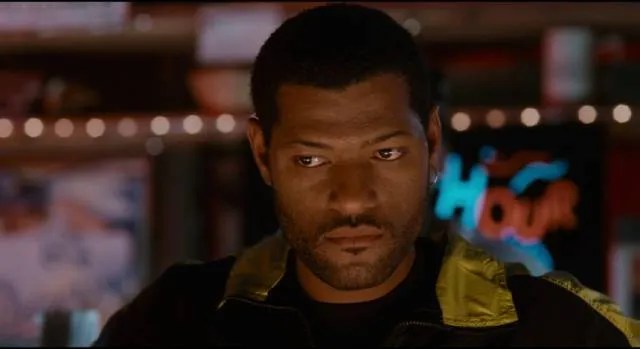
How does a uniformed officer qualify for deep cover work? Well, according to Carver, Stevens Jr has qualities that criminals have. Being that this is also a pilot program, Stevens Jr is qualified based on a different set of standards. As Stevens enters the criminal world and takes on the identity of Drug Dealer John Hull, the person he is begins to unravel. He’s surrounded by the life he would’ve lived had he not abstained from his fathers lifestyle and moved on from the world he was born into.
Stevens Jr sees himself in the little boy who lives across the hall from him. As Stevens falls deeper into a world fueled by drugs and violence, Stevens humanity is tested. While his relationship with himself becomes fractured, Stevens has one thing he can hold onto. That is the past that he looks into via the young boy across the hall. As he continues to participate in drug dealing and works his way up, Stevens experiences grief in losing his self.
One of the main focuses of Deep Cover is the way drugs, what law enforcement has done, and what they fail to do has affected black communities. This is something that Stevens Jr is familiar with from his youth. As time passes and he faces the corruption with law enforcement he becomes more comfortable with his alias John Hull. His work as a Police Officer is no longer an escape from the streets, it is part of it.
Well, with a story like this, the question becomes, without preaching, how do you set the moral compass of a film? You don’t want it to tell people, “This is good” or “This is bad” or they should think this or they should think that. How do you put the moral compass of a film within a context? And how can you use images to make people feel a sense of conflict within themselves, and question their own value system, as they watch the story?
June 2020 Q&A article Bill Due on the Making of His Essential 90s Thriller Deep Cover
Deep Cover uses a VoiceOver, letting us in on Stevens Jr’s inner monologue. A common technique in Noir. Deep Covers VoiceOver is poetic, reminiscent of Revolutionary Poet, Gil Scott-Heron. As Stevens begins to morph into Hull and his psyche becomes fractured, the VoiceOver lets us in on the workings of his mind. Fishburne does a great job at expressing these changes, as well as letting us in on Stevens weaker moments through a look or a movement. The VoiceOver is simply a technique that can keep the audience informed and on edge.
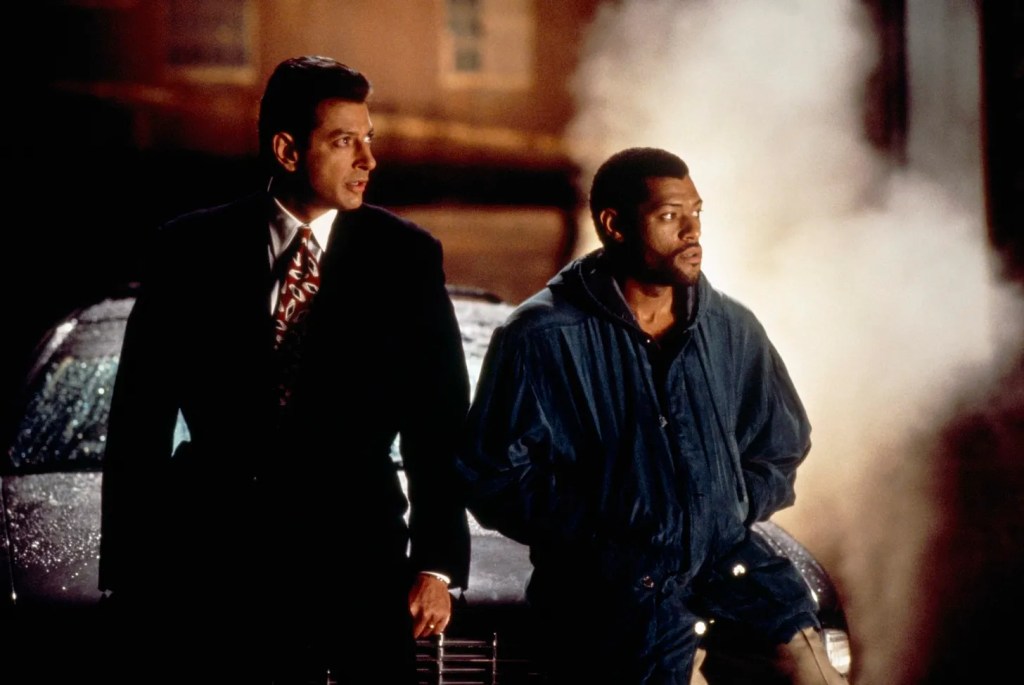
Deep Cover’s authentic nature is because of three things. The performance by Laurence Fishburne who, according to Director Bill Duke came up with Stevens moral compass. The character is loosely based on the character in Levine’s novel. A character inspired by himself. While a lot was changed from life to book, from book to script, and script to screen, it is the adaptation from reality and the presence of a moral compass that provides a true to life atmosphere. While Michael Levine is a white man, Stevens is a black man. The characters personal experiences and ties to the life he returns to while undercover adds some more nuance to Deep Cover.
During the time the film was set there was a drug epidemic occurring in black neighborhoods throughout the US. Thanks to Nancy Reagan there was a so called “war on drugs” presented by the Reagans and continued by then president George H.W. Bush. In The Betrayal of Michael Levine, an interview with former DEA Agent and author of the novel, Levine is quoted as saying,
There is no drug war. It’s a fraud. No other nation in the world has a drug war. The rest have addiction problems. We have war.
The Betrayal of Michael Levine
In getting to know Levine, we are hearing from a man with experience. Having gone under deep cover, Levine is familiar with the world that Stevens Jr was witnessing. For Levine he was gaining knowledge on how far up the problem goes. He begins to see that the communities are the product of a far bigger problem. As we watch Deep Cover we see as Stevens Jr experiences the same but from the view point of a black man in America.
Deep Cover isn’t always an easy film to watch. It’s downright sad at times. Stevens particular story may be made up for the film but the reality that impoverished and working class black children and adults face is real. From the east coast to the west coast and everything in between, there are stories of a harsh cycle of drugs and violence facing the youth of America. Black and brown children are more likely to fall into the cycles thinks to bigoted decisions. From red lining to Reagan, “say no to drugs,” to filtering drugs into black neighborhoods, some children and young adults don’t feel like they have a choice. Even when they do, circumstances can easily pull them back in. The cycle of drugs and violence in Deep Cover, is reminiscent of the cycles in black, brown, and impoverished
 Ainsley Peace
Leave a comment