
In the absence of law and order will human nature revert to savagery? That is a question that runs through the narrative of William Golding’s 1954 novel, Lord of the Flies. After a large group of English school children are marooned on an island, the children quickly descend into an uncivilized manor. More questions arise as civility is nearly lost, hanging on by a thread by the few kids who hold tight to their morals. With each passing page we are left to wonder, is the evil outside or is it within us? Are we born good or are we naturally evil?
I believe man suffers from an appalling ignorance of his own nature.
Lord of the Flies
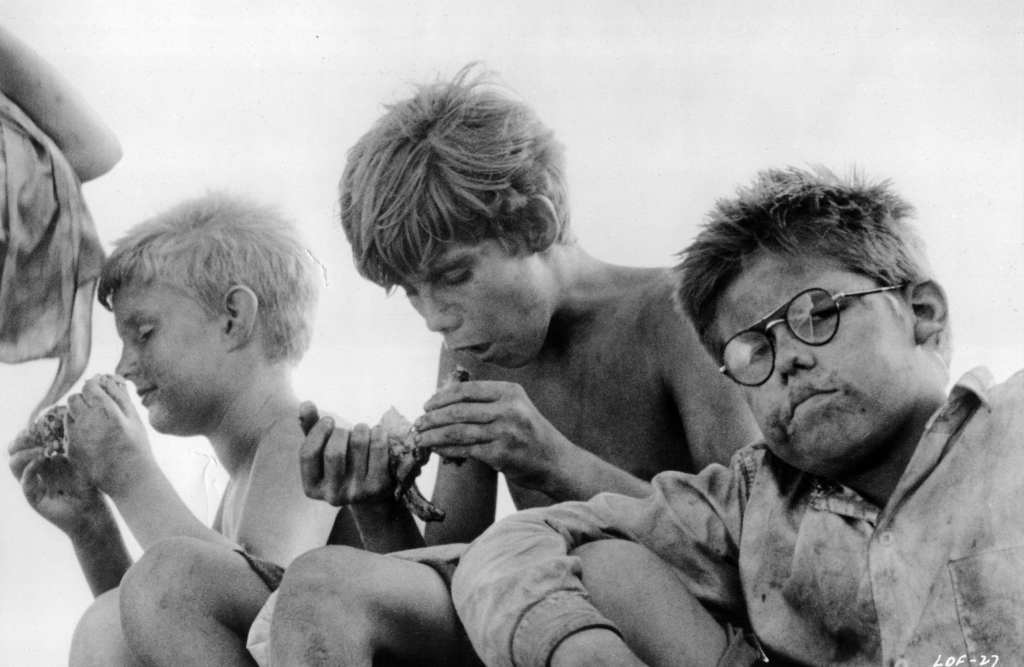
A frequently assigned reading in High School English classes, you’d be hard pressed to find someone who hasn’t at least heard of Lord of the Flies. An inspiration for deep thought, even in adulthood I refer back to the novel of young kids who quickly reverted to barbarism when robbed of their comforts. No matter the decade, Lord of the Flies remains relevant, with themes of human nature and social status, the book endures itself to audiences everywhere.
A History of the Books Publication
Released in 1954, William Golding got the idea after reading children’s novel The Coral Island. Golding found the book unrealistic and decided to write a book where the children act like children. With the support of his wife, Golding began writing. The book was rejected several times before Farber and Farber accepted it. They edited it down and while Golding made the changes he was not thrilled with them.
After the novels initial release it wasn’t a success. This was due to the novels darker themes and less than optimistic view of human nature. It didn’t take long, however, for the book to find success. By 1963 the book was considered a common classic taught in schools. That same year the first film adaptation was released having been filmed two years before.
At the start of the novel the kids were to be shown evacuating. The finished product began on the island. There were several scenes in the novel that were cut that featured the mysterious character of Simon. The final result made the character that much more of a mystery and left more room for interpretation.
Book vs its 1963 Adaptation
Like the novel, the 1963 adaptation maintains its dark themes and asks difficult questions. It presents us with the children’s dilemma as they are forced to fend for themselves. William Golding was an English Teacher at a Boarding School in England and used his experiences their as inspiration for the children.
While it doesn’t explicitly state the class the children belong to, Golding’s work and aspects of the narrative give us an idea. Piggy seems to be the only one in the book that speaks in a way more common of working class people. It has been suggested before that he could be the only one from a working class background. In the film, Piggy sounds more like his peers. I would guess that Piggy is actually the child of a teacher at the school or he may have gotten a scholarship to attend. He is pragmatic and rational. I would think that working class people would find the adjustments easier for the time being and be more practical about the situation. This is unlike the other kids, especially Jack and Roger.
Like in the novel we are introduced to Ralph and Piggy first before we are introduced to the other kids. We quickly learn that no adults have survived. The beginning of the film shows still images of school boys and other photos as music plays and the credits roll. They end along with the sound of a crash. Outside of this we never see the plane they must have been on. Both in the novel and its adaptation the war itself is not mentioned and neither is anything outside their current perdicerment. It is guessed that the novel and film are set at the time in which the book was written.

Who Are the Boys in Lord of the Flies
Everything in Lord of the Flies means something. All of the characters represent ideals and hidden truths. These boys either represent the good in all of us or the evil with in us. From Piggy’s good nature to Roger’s innate evil, the boys of Lord of the Flies are more than the faces of the story, they are the soul of the book; and in the case of some, the lack their of.
Piggy
Piggy is introduced as an inquisitive boy with glasses and asthma. When he introduces himself to Ralph he mentions not wanting to be called what the boys at school called him. Ralph does anyway and when they come in contact with the other children he introduces him as Piggy. We never learn Piggy’s real name. We know him as they did, a young bullied boy with glasses, asthma, and no name other than Piggy.
There are kids in school that read the novel and didn’t like the character of Piggy. I sympathized with him, the outsider in more ways than one. He’s the character that could be the kids saving grace and the one they ignore. It’s possible that as a kid, people look at Piggy as an annoying stick in the mud. One that sticks to the rules and the structure that kids often take for granted. It’s not until adulthood that we truly understand who Piggy is and what he represents. Piggy is logic, structure, intelligence, and civilization. Things that we tend to shy away from and lack understanding of at a young age.
Ralph
Ralph is the films main protagonist. An imperfect leader who’s indecisive nature is his greatest weakness. Like Piggy he believes in structure and is appointed leader of the boys. Despite ignoring Piggy’s wishes to not be called that, Ralph is the only one that listens to his ideas. As everything around him falls apart, Ralph struggles to gain his footing.
Like Piggy, Ralph represent civilization. He also represents democracy and order. With conch in hand, Ralph looks to be the leader of the boys but it soon thwarted by the growing discomfort of some and the lack of decorum from the others. As they fall into madness, Ralph is a leader without a group to lead.
Jack
Rude and quick to violence, Jack is the leader of the choir boys. He loses to Ralph to lead the boys but after leaving the group he becomes increasingly unstable. He gives into his primal instincts as he leaves the group behind. He is representative of the innate savagery within all of us.
Prior to crashing on the island, Jack is a bully. His leadership is based more on control and the slip of his mask is caused by the loss of what keeps him from going further. No more parents and no more rules turns Jack into everything he already was but worse. The blood and mud that Jack paints on himself shows us what he’s been hiding. An evil nature that goes beyond a school bully.
Roger
Roger starts off the story as a shy boy who has little to say. It doesn’t take long for humanity’s mask to slip. Roger quickly descends into savagery as his true self begins to show. No longer the quiet boy in the background, Roger is the ultimate hunter who ends the book as a torturer and murderer. Even Jack can’t compare to the lack of humanity within Roger.
Jack’s right hand man, Roger is the only character to murder someone. He takes pleasure in inhumane tasks. Roger is here to show us the evil that people are capable. He is the innate cruelty and brutality that can live inside us all.
Simon
Simon is the most mysterious of the books characters. Much of his scenes were cut from the book that alluded to his christ like nature. Even so the parallel between Christ and Simon remains. His spiritual nature and connection to the island are represenatitive of human goodness. He is in opposition to Jack.
While Jack and Roger represent to darker nature of humanity, Simon represents kindness and self-sacrifice. Simon finds the man in the tree and when he runs to tell the other he is ambushed by the boys who mistakenly kill him believing him to be the beast. The sacrificial lamb, Simon has proven in death that the beast is not out there but is within the children themselves.
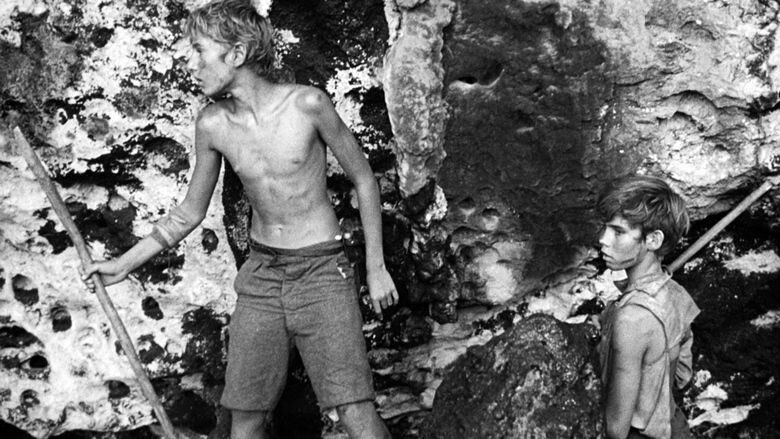
Simon Surtees (Eric) said of filming the beast scene in an interview with Bridget Osborne
“We filmed it on a beach on the mainland of Puerto Rico, at Aguadilla. It was getting dark and we all had to improvise. Ralph and Piggy, Sam and Eric turn up, the only ones outside Jack’s group, and we all had to rush at Simon with spears. One of the crew ran off, he was so scared.”
“You were crying? What are you crying for?”.
The ending of William Golding’s Lord of the Flies released in 1954
Ralph, who has just been rescued, cries and the officer then states,
“I wept for the end of innocence, the darkness of man’s heart, and the fall through the air of the true, wise friend called Piggy.”
Rife with Symbolism
From our first meeting of kids on the island till the very end, Lord of the Flies is rife with symbolism. The novels characters all represent something and the devices they use, even the island itself.
The Island
Paradise, Freedom, and the Garden of Eden
They had guessed before that this was an island: clambering among the pink rocks, with the sea on either side, and the crystal heights of air, they had known by some instinct that the sea lay on every side. But there seemed something more fitting in leaving the last word till they stood on the top, and could see a circular horizon of water. Ralph turned to the others. “This belongs to us.”
The kids had no say in being on the island, but Ralph’s quote shows the belief of some that human’s can own the earth. Today we see as American Imperialism destroys lives all over the world. Even its own citizens are not safe. British Imperialism and European Superiority gave them the idea that they could conquor the world. This lead to the deaths of many civilizations and many deaths of indigenous communities. Genocides continue as the USA, England, France, and others refuse to let go of the power they hold. While the novel specifically speaks to Englands superiority, the novel engages with the changing times and the existance of others with the same beliefs.
The Conch
Leadership and Democracy
And another thing. We can’t have everybody talking at once. We’ll have to have ‘Hands up’ like at school.” . . . “Then I’ll give him the conch. . . . I’ll give the conch to the next person to speak. He can hold it when he’s speaking.”
As said by Ralph
“Conch! Conch!” shouted Jack. “We don’t need the conch anymore. We know who ought to say things. What good did Simon do speaking, or Bill, or Walter? It’s time some people knew they’ve got to keep quiet and leave deciding things to the rest of us.”
As said by Jack
Piggy’s Glasses
Intelligence and civilisation
“His specs—use them as burning glasses!”
As said by Jack
Fire
Hope
“There’s another thing. We can help them to find us. If a ship comes near the island they may not notice us. So we must make smoke on top of the mountain. We must make a fire.”
As said by Ralph
The Pigs Head and the Beast
The beast in us
“What I mean is . . . maybe it’s only us.”
As said by Simon.
The Masks aka the Mud and Blood
For Jack and Roger its like putting on their real selves, for the others it’s cover up their humanity and giving into savagery. The kids understood only too well the liberation into savagery that the concealing paint brought. As they covered themselves in the blood of pigs and the mud of the island, they could become whatever it was they needed to be. They could let go of the civilization they once knew. When they washed it off they could be themselves again. If only it was that easy.
While the masks they wore could give them a liberating sense of letting go what they lost could never be brought back. The innocence of the children is destroyed as they follow the lead of Jack and Roger who’s humanity was always a mask. When we come to the end we see as the sailors look upon the children. Ralph running, the look of pain and guilt on his face. The others running after him stopped in their tracks. The question is now, who will they be when they return to civilization.
The Simplicity and Savagery in Lord of the Flies (1963)
Lord of the Flies released in 1963 was made on a shoestring budget and filmed in Puerto Rico. The children in the film were unknowns, most of which had acted prior to the filming of Lord of the Flies. Many of them never acted again. This adds to the moves authentic nature as the film didn’t rely on known children actors to carry the film. It also helped its audience to connect with the marooned children.
This first adaption of the novel is close to its source material. The biggest difference is the amount of savagery that is depicted in the book versus the movie. Much of what is in the book would be harder to depict at the time the film was made; and on a shoestring budget that became even harder. While all of the worst parts of the book may not be depicted theroughly it still manages to depict the children’s decent into savagery.
In the film version, Piggy doesn’t have the stronger working glass dialect that he does in the novel. This doesn’t really hinder the film or character too much but it would have been a great detail to have. The character of Percival does not have much todo in either the book and film but he is still important to the overall story of Lord of the Flies. Alongside the older kids he represents who they were and the childlike innocence that has been lost. I would’ve liked to see a little more of him in the film, it would’ve given the film a little more balance as the other descended into savagery. It would also connect us to his clinginess to his life prior to being morooned on the island.
Despite the films dark nature the movie itself feels really laid back. The small budget, short shooting schedule and on location filming would have you believe that the film contained a lot of structure. According to actors on the film that was not the case.
We actually did a lot of what you see in the film. It was the least-directed film I’ve ever heard of.
Roger Allan in a 2013 interview with Tamara Cunningham
William Golding’s Lord of the Flies is one of the most important English language books of the 20th century. Its impact remains strong and its willingness to question so-called British values is astounding. Audiences all these years later are still fascinated with the story of several school boys marooned on an island. The novel has inspired other books, films, and television series. While they’ve done their own thing and asked their own questions they still owe a great debt to the book that was willing to show the worst of humanity in our most innocent, our children.
 Ainsley Peace
Leave a comment